A little over a week ago, a young boy arrived at one of our DiveInclusive pool sessions for his first experience of scuba diving.
He was nervous. You could see it.
So we took things slowly. We explained what we were going to do, repeated skills when he needed us to, and let him progress at his own pace. But something began to change surprisingly quickly.
Every time he completed a skill, his confidence grew. And when he felt he hadn’t quite got something right — even when we thought he’d done perfectly well — he’d ask to do it again.
Before getting into the water, we’d told him that we’d spend most of the session in the shallow end and, if he felt confident enough, perhaps venture into the deep end later. Given how nervous he’d initially been, we weren’t convinced we’d get that far.
He had other ideas.
He wanted to go deeper.
On his first attempt, he struggled to equalise his ears, so we returned to the surface. At that point, we were quite prepared to leave the deep end for another day.
He wasn’t.
He wanted to try again.
This time his ears cleared. We descended, and almost immediately he looked across and gave the signal that everything was OK.
By the end of the session, this was the same young person who’d walked in unsure of what to expect. As he climbed out of the pool, he said:
“This is the best thing I have done in my entire life.”
That moment captures something we see again and again at DiveInclusive.
Of course, we want young people to learn how to scuba dive safely. But sometimes the most important thing they discover underwater isn’t a diving skill at all.
It’s what happens when they realise: I can do this.
When Things Don’t Go to Plan
Scuba diving teaches you fairly quickly that not everything will always go exactly to plan.
A skill might take longer to master than expected. Your buoyancy might not quite cooperate. You may struggle to equalise. Even experienced divers encounter situations that require them to stop, think and adjust.
And that’s where two of the most important qualities in diving come into play: patience and calmness.
Underwater, frustration rarely makes a problem better. Panic certainly doesn’t. You learn to slow things down, remember your training, communicate with the people around you and work through the problem in front of you.
We saw a small example of that in the pool session above. When our young participant couldn’t equalise on his first attempt at the deep end, that wasn’t failure. He surfaced, listened, tried again and succeeded.
But perhaps there’s an even bigger lesson in that.
Sometimes you can prepare properly, follow your training and still find that something doesn’t work out as expected. Diving doesn’t teach us that we can eliminate every problem. It teaches us how to respond when one appears.
You learn from what happened. You adjust where you can. You give yourself a better chance next time.
For a young person, those lessons reach far beyond the swimming pool.
School, friendships, sport and eventually adult life won’t always go to plan either. Getting something wrong the first time doesn’t have to mean I can’t do this. Sometimes it simply means: What can I learn? What can I change? And can I try again?
Taking Responsibility — For Yourself and Others
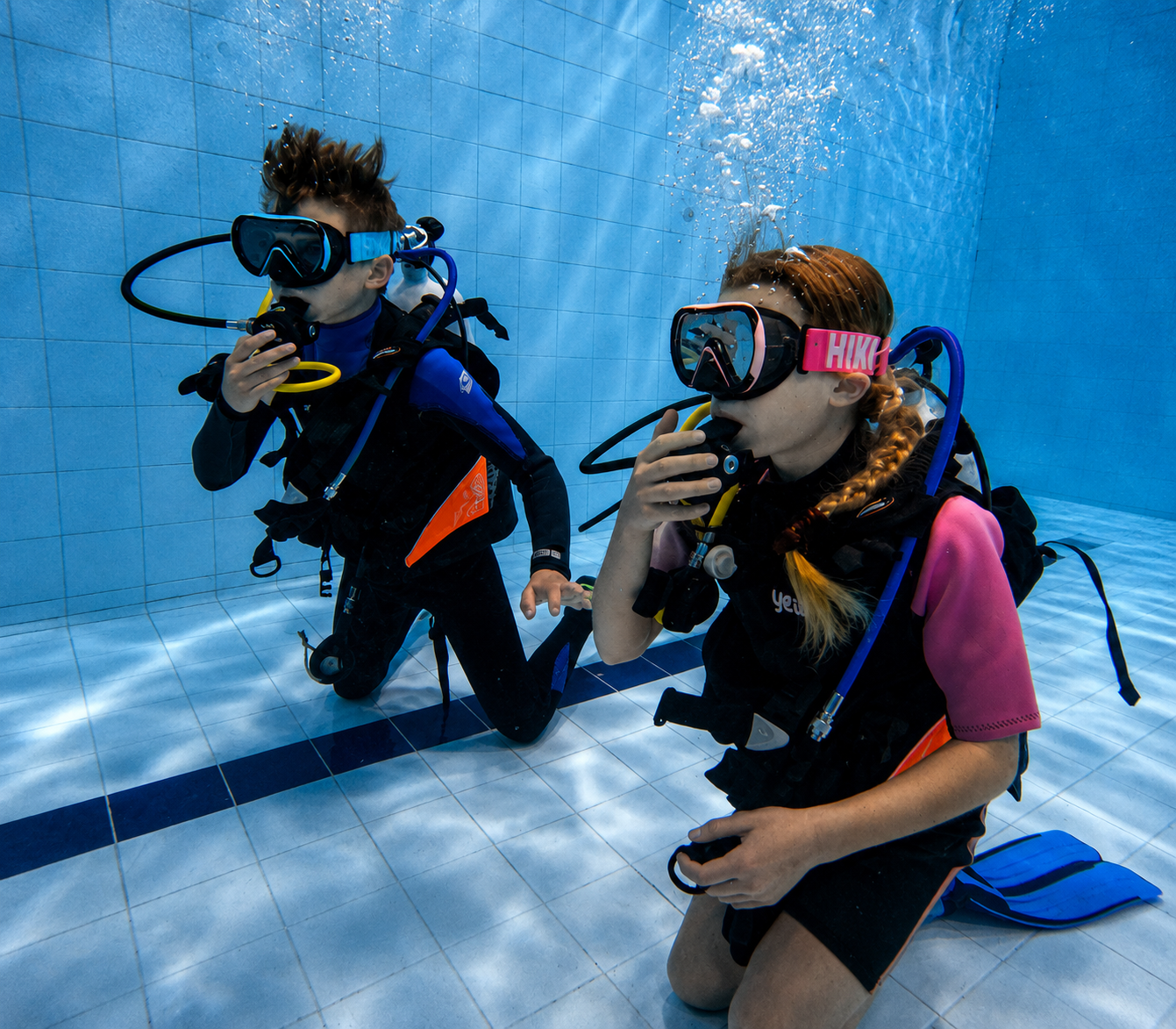
From the outside, scuba diving can look like an individual sport. You put on your own equipment, breathe from your own air supply and move through the water under your own control.
But scuba is just as much about the person beside you.
Most recreational diving is built around the buddy system. You dive with someone else, communicate with them, look out for them and, if something goes wrong, you’re prepared to help.
There’s an interesting lesson in that: being able to look after someone else starts with taking responsibility for yourself.
If your buddy needs air, you can only help if you’ve managed your own air properly. If they have a problem with their equipment, you’re much more useful to them if you’ve checked yours, understand how it works and know that the equipment you may need to rely on is ready to do its job.
Being a good buddy isn’t simply about being willing to help. It’s about being prepared enough to help.
And the same principle works in both directions.
You do everything you reasonably can to prepare yourself, while knowing that the person beside you has hopefully done the same. That creates something important underwater: trust.
It doesn’t mean nothing will ever go wrong. But when something does happen, you’re part of a team in which everyone has a responsibility to themselves and to one another.
For young people, there’s a valuable lesson in that balance.
Take responsibility for yourself. Be prepared. But don’t live as though you’re the only person who matters.
Sometimes someone else will need you.
And sometimes you’ll need them.
Sometimes the Barrier Isn’t Ability
One of the things we’ve learned through DiveInclusive is that access isn’t always about affordability.
Sometimes, people simply need to know that an opportunity exists — and that it exists for them.
For many of the families we’ve met, scuba diving wasn’t necessarily something they had previously considered for their children. Not because their children couldn’t do it, but because nobody had ever put the possibility in front of them.
Sometimes that’s all it takes.
“This exists. Your child can do this.”
We’ve now seen young people who first encountered scuba through DiveInclusive go on to become certified divers. Others are currently progressing through structured training programmes.
Would every one of them eventually have discovered scuba without us? Perhaps. We’ll never know.
But we do know that some of the young people we’ve worked with would not be on the diving journeys they’re on today if someone hadn’t first opened that door.
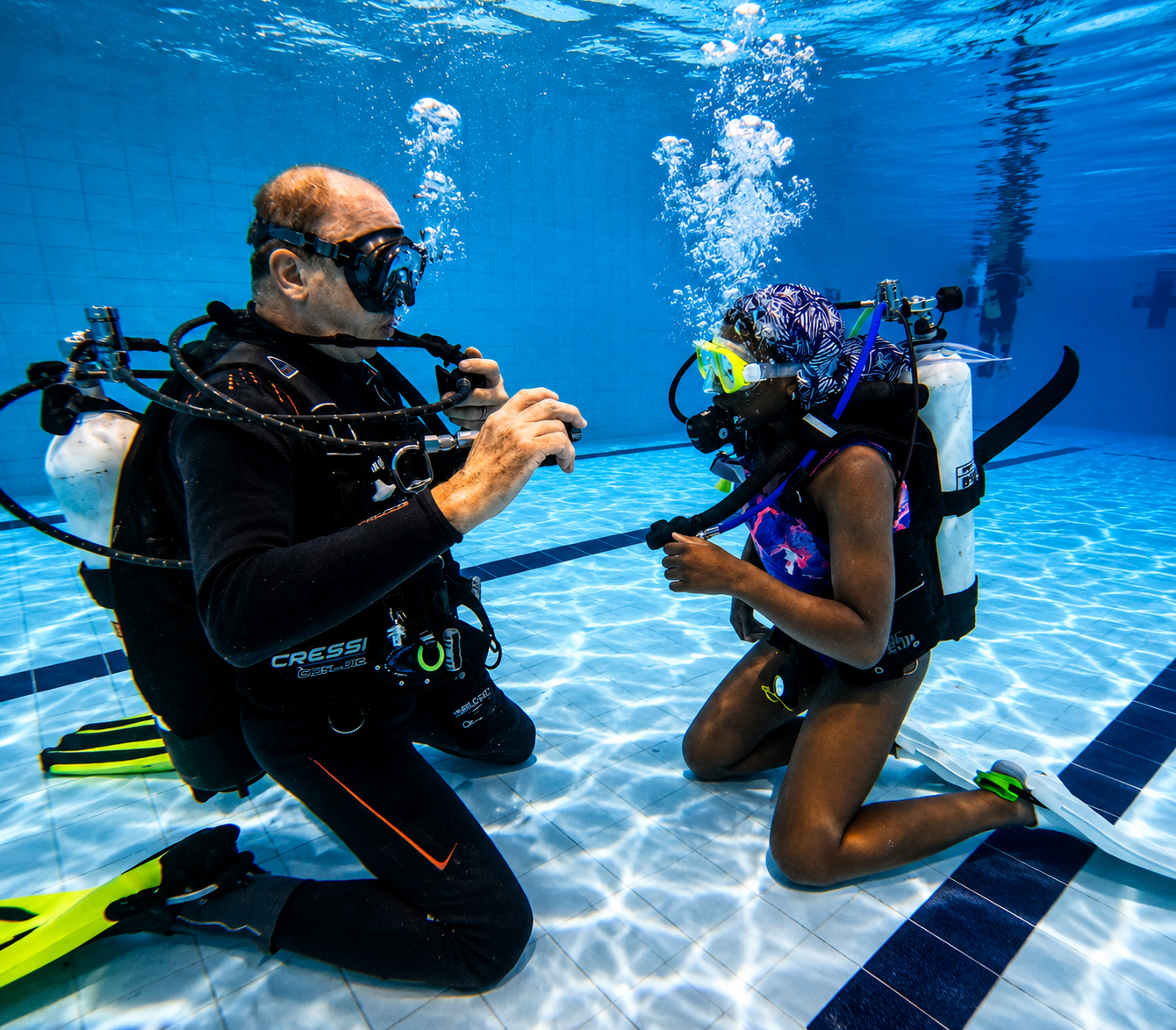
One of our current participants, for example, travels with her family from Surrey to Swindon to take part in our SSI Explorers programme. That’s a significant journey for a pool session.
And watching her in the water, you begin to understand why they make it.
She’s a natural. Each time we see her, she’s developing her skills, becoming more comfortable in the water and growing in confidence.
The ability was already there.
The opportunity simply gave it somewhere to go.
We can’t know what a young person might be good at, passionate about or even fall in love with if they never get the chance to try it.
Sometimes opening a door is enough.
What Does Success Really Look Like?
Of course, we’d love every young person who walks through our doors to fall in love with scuba diving.
We’d love every Try Scuba participant to want another dive. We’d love those who progress onto our pathway programmes to become certified divers. And who knows? Perhaps some will eventually become instructors or other diving professionals themselves.
But we also know that won’t be everyone’s story.
Some young people will try scuba once and decide it isn’t for them. Some may progress further before stopping. Others might earn their certification and, for whatever reason, rarely dive again.
That doesn’t mean the experience was wasted.
One of our participants completed all of her pool training and was just four qualifying dives away from becoming an Open Water Diver. But when the time came to take that final step, she told us that she didn’t feel comfortable continuing.
She was worried she’d disappointed us.
And yes, of course we would have loved to see her finish. She’d worked incredibly hard and had come so close.
But diving has to be safe. And part of being safe is being able to say “I’m not comfortable with this” and knowing that you’ll be listened to.
More importantly, she told us something else: despite deciding not to continue, she’d learned a lot from everything she’d already done.
That matters.
Because perhaps the minimum we can hope to give every young person who comes through DiveInclusive isn’t a diving certification.
Perhaps it’s an experience that shows them something about themselves.
The courage to try something completely unfamiliar. The curiosity to step into a world they might never have imagined themselves entering. The confidence that comes from mastering something they initially found difficult. And even the self-awareness to recognise their own limits and say when something doesn’t feel right.
We hope scuba becomes a lifelong passion for every young person we introduce to it.
Realistically, it won’t.
But if a young person leaves us having discovered even a little more about what they’re capable of than they knew when they arrived, then something worthwhile has already happened.
What Stays With Them
When a young person takes their first breath underwater, we have no idea where it might lead.
For some, it may simply be an experience they’ll remember for years. For others, it might be the beginning of a journey towards becoming a certified diver. And for a few, perhaps scuba will become something they carry with them for the rest of their lives.
We hope for all of those possibilities.
But what matters to us is that somewhere along the way, they’ve had the chance to discover something about themselves too.
That they can be nervous and still try.
That something going wrong doesn’t mean giving up.
That they can take responsibility for themselves while also looking out for someone else.
That it’s okay to recognise their limits.
And perhaps most importantly, that there may be things they’re capable of that they simply haven’t discovered yet.
That’s what we see when we watch young people learning to scuba dive.
Yes, they’re learning how to breathe underwater, use unfamiliar equipment and move through an entirely different environment.
But they’re also learning about themselves.
And long after the mask comes off, the fins are put away and the bubbles disappear, we hope some of those lessons stay with them.
Because scuba diving can be an incredible thing to learn.
But sometimes, what you learn about yourself along the way matters even more.